
By: Euphresia A. Okwakori
In Masendebale village, nestled in the remote areas of Busia County, Kenya, a quiet revolution is taking root. A revolution in good management practices to make efficient and sustainable use of water resources and promote catchment conservation measures to improve water quantities and quality. Key to this is the Lunabo Water Resources Users Association (Lunabo WRUA), comprising water users, riparian landowners, and other stakeholders who have formally and voluntarily associated for the purposes of sharing, managing, and conserving common water resources in the Lower Nzoia basin.
Every morning, members of Lunabo gather around tree nurseries that hum with life. Rows of bamboo shoots and indigenous saplings sway gently in the morning breeze, attended to by hands that reflect hope.
Here, philanthropy doesn’t arrive in trucks, nor does it trickle down through big grants or outside donors. It begins with the people themselves; neighbors helping neighbors, bound by the belief that caring for the land is also caring for one another.
“We realized that we couldn’t wait for help to come from outside,” says Rosemary Achieng, one of the founding members, her voice steady but warm. “Our land, our water, our trees, these are our treasures. If we take care of them, they take care of us.”
Redefining Philanthropy
Across Africa, philanthropy has long been viewed through an external lens— defined by foreign aid, donor funds, and international interventions. Yet beneath the surface, a more organic form of giving thrives, shaped by African values like Ubuntu (I am because we are), Harambee (pulling together), and Ujamaa (cooperative economics).
This philosophy of homegrown giving lies at the heart of Lunabo WRUA’s work. The association, which brings together over 280 active members—farmers, women, youth, and artisans—embodies what community-led philanthropy looks like in action.
Supported by the National Government through the Kenya Forestry Research Institute (KEFRI), Lunabo members received essential capacity building on the establishment and management of a tree nursery through a donation of 18 kg of various tree seedlings. Lunabo members say that through this initiative, they now boast of three tree nurseries with over 1000 species that enhance catchment conservation efforts. So far, the WRUA has restored and conserved 9kms of both Lunabo and Masogo Rivers.
With more support from Kenya Water Towers, GiZ, and the Western Kenya Water Project, Lunabo WRUA focuses on locally driven climate adaptation and mitigation strategies. Their approach is simple yet transformative: equip communities with the skills and tools to restore their environment, improve livelihoods, and build resilience, one project at a time.
“Philanthropy here is not about money,” explains Winbold Wangombe, the association’s chairperson. “It’s about people coming together, each contributing what they have– skills, time, or labor— to make life better for everyone.”
In a county characterized by increased temperature variability throughout the year (average high temperatures of 28°C) and significant annual rainfall of 1525MM, Busia has become prone to climate change impacts, including floods, prolonged dry spells, erratic rainfall, changes in farming seasons, landslides, and lightning.
Having witnessed some of these natural calamities, Lunabo WRUA has emerged as a living example of what happens when a community refuses to be a victim of climate change—and instead becomes its own solution.
With the knowledge gained on climate change, Lunabo RWUA continues to emphasize the importance of integrating climate-smart practices in community projects to ensure environmental sustainability and improved livelihoods.
Greening Livelihoods, Protecting Ecosystems
The group’s tree nurseries, now boasting more than 1,000 seedlings of indigenous and conservation species—including bamboo—have become a symbol of renewal. They supply seedlings to members to plant for soil and water conservation and erosion control while restoring degraded land and building climate resilience.
Bamboo, in particular, has become the community’s “green gold.” Beyond its environmental value, it’s also a source of income as an alternative to charcoal and firewood, thereby reducing dependency on traditional wood fuel. Lunabo WRUA has successfully established over 330 acres of bamboo, with more than 80 acres of mature bamboo.
To enhance sustainability, the association has ventured into bamboo value addition by fabricating pillow case bamboo briquettes at the National Government, Butula Enterprise Development Center. The briquettes are produced through a process known as carbonization, which transforms harvested bamboo into high-quality fuel.
According to the livelihood committee chairperson, Bravin Wesonga, cassava flour is the most efficient and clean-burning binder for making the briquette, and therefore members are encouraged to integrate cassava cultivation into their bamboo farming systems to ensure a steady supply, whilst contributing to food security.
But with a production capacity of 1.5 tons per day, the association lacks a specialized dryer, which limits daily production and the WRUA’s ability to meet growing demand from the local hotel industry, institutions, and households who appreciate the efficiency, affordability, and environmental benefits of bamboo briquettes.
Water, Bees, and A Circular Economy
In Busia, water is both a lifeline and a challenge. Frequent, prolonged droughts and flash floods have disrupted farming patterns and livelihoods. To tackle this, Lunabo WRUA constructed a multi-purpose fish pond designed to capture surface runoff during rainy seasons.
The pond has become a model of a circular water economy: it supports aquaculture, provides irrigation water for the nursery during dry spells, and prevents downstream flooding. The soil excavated from the pond is used for brick-making, creating yet another income stream for members.
“Nothing here goes to waste,” says Wangombe, one of the beekeepers, with a smile. “That’s our philosophy: use what you have wisely, and nature will give back.”
Nearby, a small apiary buzzes with life. The association manages 50 beehives, tended by trained beekeepers. The honey is sold locally, while bees play a critical role in pollinating trees and crops—boosting yields and biodiversity in the surrounding farms.
“When we first started beekeeping, it was just for honey,” Wangombe recalls. “But soon we realized how important bees are for our plants and for the environment. Now, when we see bees around our farms, we see hope.”
Women at The Heart of Transformation
Women stand at the core of Lunabo WRUA’s transformation story. Many have adopted energy-saving stoves, both permanent and portable, which have reduced household firewood use by nearly half. Beyond their environmental benefits, these stoves have changed the social dynamics of over 600 households in unexpected ways.
“Before, I spent hours looking for firewood,” says Grace Khamala, a mother of four. “Now with the improved stove, I use less wood and have more time for my children and my garden.”
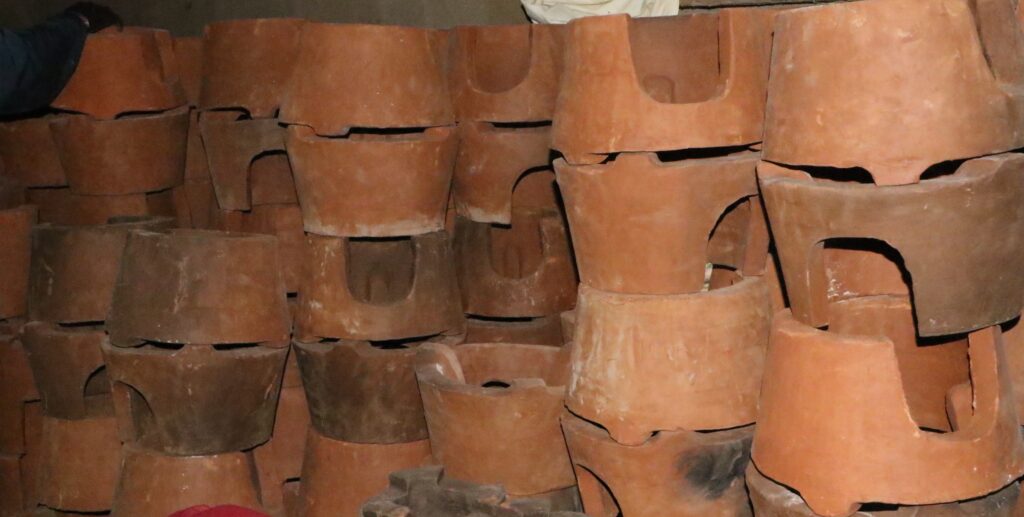
Grace laughs as she shows off her newly built kitchen. “The stove has added beauty to our home—and even spiced up our marriage!” she says with a broad grin. “Because the kitchen is now clean and smoke-free, my husband often joins me there. We cook together and talk about our day.”
For Millicent Karani, who owns two permanently built rocket stoves, the change has been nothing short of life-altering.
“I used to suffer from coughing and chest pains because of the smoke,” she says. “Now I breathe clean air, and my health has improved. The stove has given me back my strength.”
These small yet powerful shifts—more time for families, improved health, reduced deforestation—are rippling across Masendebale, reshaping daily life and reinforcing the community’s commitment to environmental and health stewardship.
Beyond Projects: A Philosophy of Giving
What makes Lunabo WRUA remarkable isn’t just the projects—it’s the philosophy that binds them. Each initiative is a collective effort, powered by voluntary labor, local knowledge, and shared purpose. Members contribute seedlings, tools, or time, and others offer their expertise. The association itself runs on a spirit of Harambee, a call to “pull together” that has defined Kenyan communal life for generations.
“We may not have much money,” says Khamala. “But we have each other. When we work together, we can solve our own problems.”
This sense of ownership has not only sustained the group but also strengthened its credibility. When external partners like GiZ or the Western Kenya Water Project provide support, it builds on an existing foundation of trust and initiative, not dependency.
“External partners walk with us; they don’t lead us,” Wangombe emphasizes. “They see that we already have the will. What they bring are skills and connections. But the heartbeat of Lunabo WRUA is our people.”
Building Resilience, One Community at a Time
Busia County government has recognized Lunabo WRUA as a model for climate-smart community action, inspiring neighboring villages to adopt similar approaches. The group now organizes exchange visits for other water resource associations, sharing their experiences in bamboo farming, beekeeping, and energy conservation.
“When people visit and see what we’ve done, they realize it’s possible to change things,” says Achieng. “It gives them courage to start their own projects.”
Their efforts align with Kenya’s broader push for community-led adaptation, where local knowledge and participation form the backbone of climate resilience strategies.
Experts in the philanthropy space say this approach reflects a broader shift in Africa—from dependency on external aid toward self-determined, community-driven development.
As Dr. Bhekinkosi Moyo, a leading voice on African philanthropy, once noted, “True African giving is not charity—it’s solidarity.” Lunabo WRUA embodies that spirit fully.
Investing in The Future
As Kenya and the wider continent grapple with the growing impacts of climate change, Lunabo WRUA’s story offers valuable lessons. It shows that sustainable change doesn’t always depend on large-scale funding—it can emerge from within, fueled by shared values and local ingenuity.
By blending traditional cooperation with modern sustainability practices, Lunabo WRUA is not only protecting its environment but also reshaping the story of African philanthropy. It demonstrates that philanthropy can be as simple—and as powerful—as a group of villagers pooling their energy to plant trees, build stoves, and care for their land.
In Masendebale, hope now grows leaf by leaf, hive by hive, brick by brick. Each seedling planted, each stove built, each beehive buzzing tells a story of a people reclaiming their power—proving that the most enduring change begins not from the top down, but from the roots up.